The other day, a leader told me he planned to fire someone his company had promoted just a few months ago.
What struck me was how quickly someone can go from being a “rising star” to being let go. As managers, we need to ask ourselves: What role did I play in this outcome?
Although the leader claimed he was providing guidance, he said that the employee believed he was doing okay. The real issue could be the lack of clear, specific feedback. Did the manager communicate where the employee was falling short? When someone does need to be fired, it shouldn’t come as a surprise.
Often, this is a major gap in leadership, and why difficult conversations matter.
Worth the share
The Center for Creative Leadership provides a solid framework for difficult conversations by starting with extensive prep work before the conversation takes place. Putting energy into understanding why you need to have the conversation, recognizing how your emotions may play a role, and leaning into the facts, you can set the stage for a productive discussion.
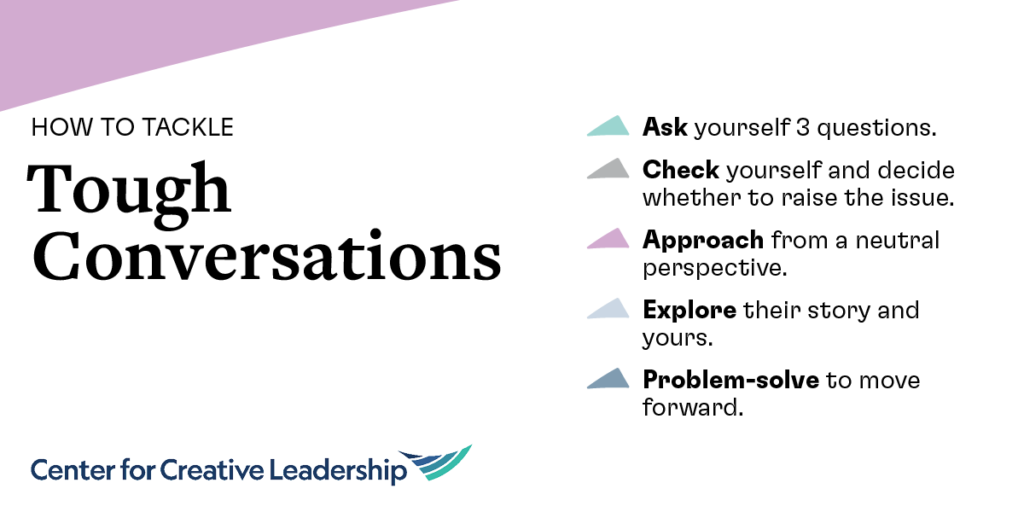
Here are the five steps to CCL’s framework:
Prepare for a difficult conversation by walking through the “3 conversations” ahead of time: sort out what happened, sort out your feelings, and ground your identity.
Check your purposes and decide whether to raise the issue. Do you even need to have the conversation in the first place? For some of us, we jump into the conversation without asking questions like “What do I want to accomplish?” Why does this matter to me?” “Can I let it go?”
Start from the “third story.” Be collaborative with the other person by approaching it from a neutral third-party position, acknowledging that there are different ways to look at it. Sort through options and problem-solve it together.
Explore their story and yours. Ask open-ended questions, listen to understand. Be curious. Admit you don’t read minds. Be open to hearing their POV. Focusing on the facts is key.
Problem-solve. Discuss different ways to solve the issue or problem, with both of you contributing to come up with a solution that you can live with.
I acknowledge that this is not an easy task. Building the muscle to have difficult conversations is critical to advancing in your role as a manager and leader. Too many of us shy away from crucial conversations.
For more information on these five steps, please read the full article from the Center for Creative Leadership. Also, the book Crucial Conversations offers more information and frameworks on the topic.
Recently, I had lunch with two senior HR leaders from a large corporation, who are clients of mine. We discussed difficult conversations and how many professionals find it challenging to have tough conversations with colleagues. One of the senior HR leaders suggested that more than 80% of professionals struggle with having difficult conversations. I agree!
How does your management style align with having tough conversations with colleagues and direct reports?
If this is a challenge for you, take the necessary steps to address it. Having difficult conversations is critical to moving conversations and careers forward.